
The Forgotten Faces of the Age of Exploration
Reexamining some of the historical figures of the Age of Exploration
When most Americans picture the first Spaniards who entered the Southeast, they often imagine men who looked much like modern Hollywood portrayals: pale-skinned Europeans wearing polished armor, visually distinct from the Indigenous peoples they encountered.
But what do the historical sources actually say?
The question is important because the Age of Exploration occurred centuries before modern racial categories hardened into the labels we know today. The world that produced Columbus, Narváez, De Soto, and Juan Pardo emerged directly from the cultural crossroads of Iberia—a land shaped by centuries of interaction among Christians, Muslims, Jews, Berbers, Africans, and diverse Mediterranean peoples.
Rather than relying on modern assumptions, we can turn to contemporary descriptions and historical accounts to ask a simple question:
How did the people of sixteenth-century Spain describe themselves and their leaders?
The answers are often more complex than modern audiences expect.
The Iberian World Before the Age of Exploration
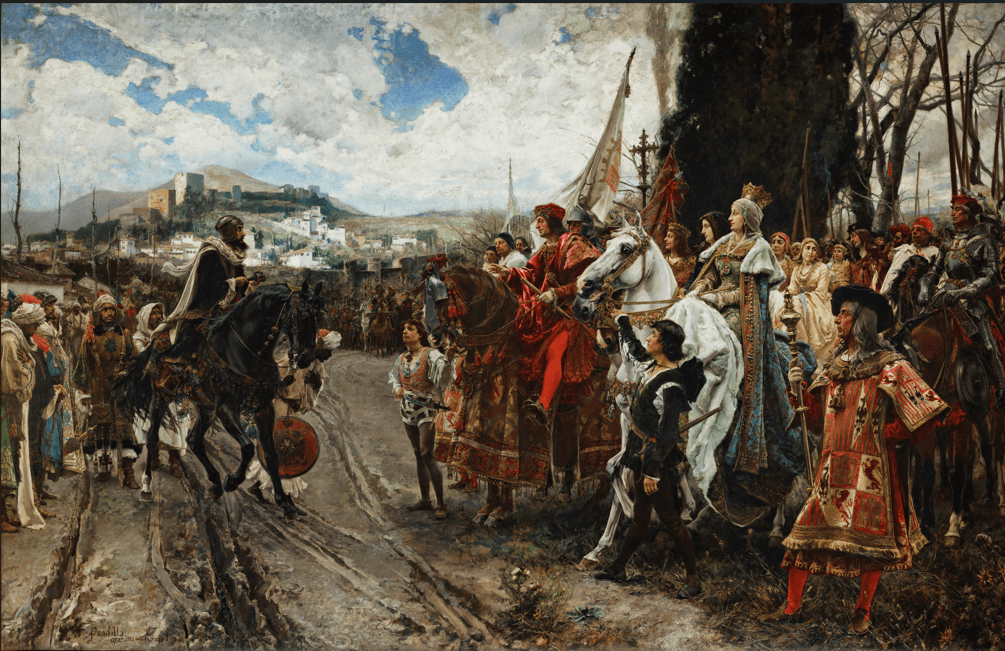
The voyages that carried Spaniards into the Americas began immediately after the political upheavals of late fifteenth-century Spain.
In 1492, Granada—the last Muslim kingdom in Iberia—fell to Ferdinand and Isabella. The same year witnessed the expulsion of Jews from Spain and the beginning of a new era of religious conformity. Yet the populations of Spain and Portugal did not suddenly become ethnically uniform.
Centuries of interaction among Christians, Muslims, Jews, Berbers, and Africans had already shaped the people of the peninsula.
As historian Fernand Braudel observed:
"In the sixteenth century, Seville and the Andalusian hinterland, still half-Moslem and hardly half-Christian, were engaged in sending their men to settle whole areas of Spanish America."
The men who crossed the Atlantic came from this world.
To understand them, we must examine how contemporaries described their appearance.
Ferdinand and Isabella: The Monarchs Behind the Voyages
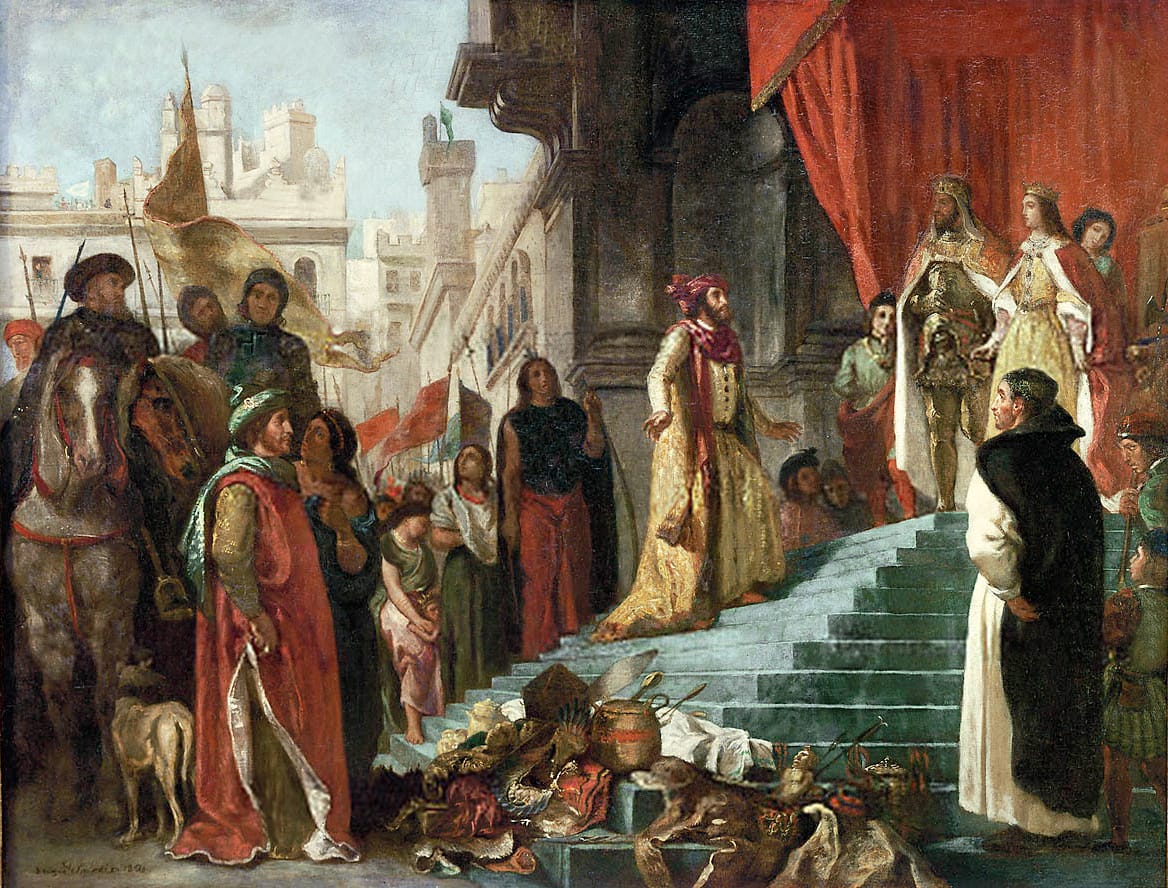
Delacroix, Eugène. Christopher Columbus Before Queen Isabella. 1839. Oil on canvas. Toledo Museum of Art.
One of the most revealing descriptions comes from an English history of Spain published in 1699.
Describing Ferdinand and Isabella, the author wrote:
"their Complexion somewhat swarthy."
Today the word swarthy is often ignored or misunderstood. In early modern English usage, it generally referred to a dark, brown, or olive complexion.
The description does not mean Ferdinand and Isabella were Africans. It does, however, demonstrate that contemporaries did not necessarily view the founders of Spain's overseas empire as possessing the pale complexion often associated with modern northern European stereotypes.
Henry IV of Castile
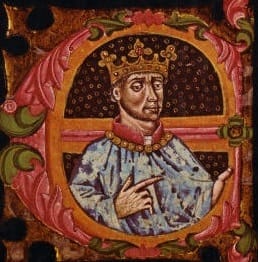
Unknown author. Henry IV of Castile. January 29, 1463.
Another early source provides an even more specific description of a Spanish monarch. In this case, Isabella's half-brother.
A 1701 history of Spain describes King Henry IV of Castile as having:
"his complexion ruddy and swarthy together."
This combination appears repeatedly in historical descriptions.
The word ruddy typically referred to a reddish
Another early source provides an even more specific description of a Spanish monarch. In this case, Isabella's half-brother.
A 1701 history of Spain describes King Henry IV of Castile as having:
"his complexion ruddy and swarthy together."
This combination appears repeatedly in historical descriptions.
The word ruddy typically referred to a reddish tone in the face, while swarthy referred to a darker underlying complexion.
Together, the terms suggest a complexion that modern readers might describe as olive, brown, sun-darkened, or Mediterranean rather than pale.
Bartolomé Carranza: "The Black Friar"
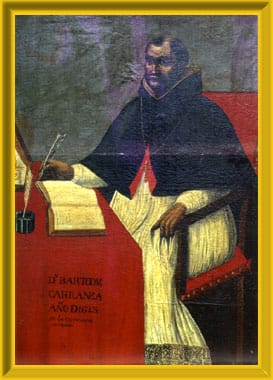
Portrait of Bartolomé Carranza de Miranda. Reproduced from the Dictionary of Alternative Christian Thought, "Carranza de Miranda, Bartolomé (1503–1576)," Eresie.it.
In William Prescott's History of the Reign of Philip II, the prominent Spanish churchman Bartolomé Carranza is described as:
"the black friar"
and Prescott explains that the nickname was:
"applied not less to his swarthy complexion than to the garb of his order."
This passage is particularly important because the author explicitly states that Carranza's complexion contributed to the nickname.
Again, the description does not place Carranza into a modern racial category.
It does, however, demonstrate that dark or swarthy complexions were recognizable and noteworthy among prominent Spaniards.
Jerónimo de Aguilar: A Spaniard Described as Dark as an Indian
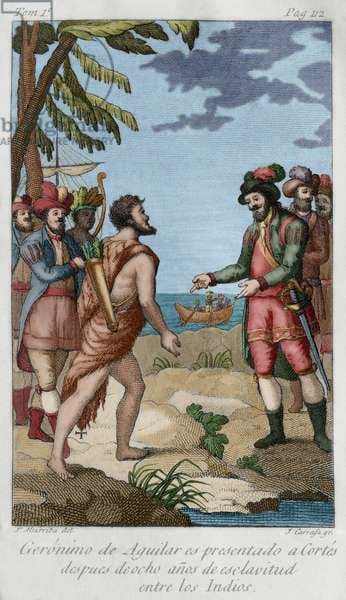
Jerónimo de Aguilar es presentado al cacique después de ocho años de esclavitud entre los Indios. Hand-colored engraving, eighteenth century.
One of the most striking descriptions concerns Jerónimo de Aguilar, the Spanish survivor who spent years among the Maya before assisting Hernán Cortés.
Historian David Weber notes that Aguilar had become:
"as dark as an Indian."
This observation is remarkable because it comes from a direct comparison between a Spaniard and the Indigenous peoples of Mesoamerica.
Whether the result of sun exposure, lifestyle, ancestry, or a combination of factors, the description reminds us that the visual boundaries modern people often imagine between Europeans and Indigenous Americans were not always as stark as popular imagery suggests.
Diego de Vargas and the Olive Complexion
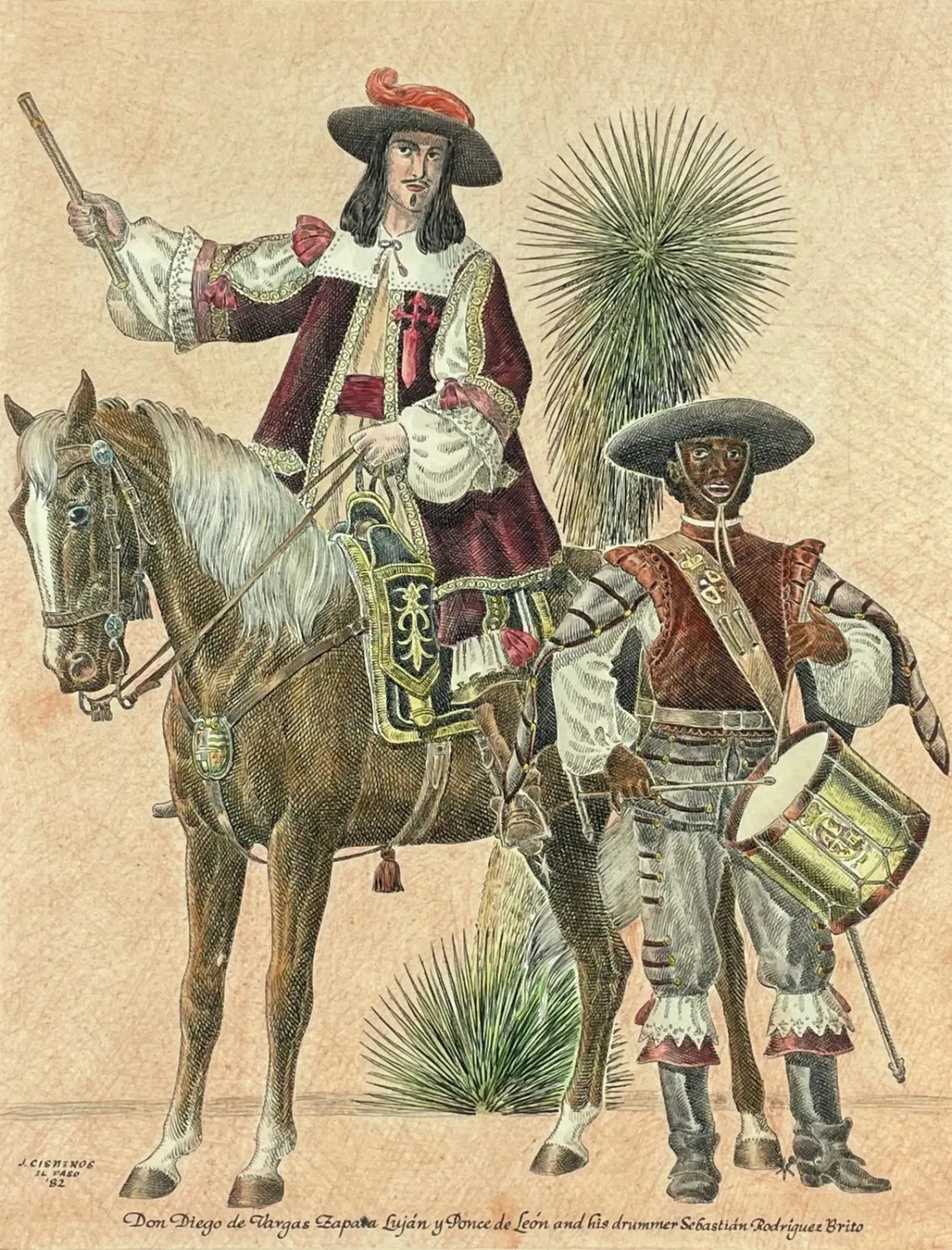
Don Diego de Vargas Zapata Luján y Ponce de León, Governor of New Mexico, accompanied by his drummer Sebastián Rodríguez Brito. Illustration by José Cisneros, 1982.
Moving into the seventeenth century, descriptions continue to reveal the diversity of Iberian appearance.
One account described Spanish governor Diego de Vargas as:
"tall, dark and thin."
Another described him as having a:
"smooth and pale olive color."
Such descriptions fit comfortably within the broader pattern of Mediterranean and Iberian complexion terminology found throughout the historical record.
The Conquistadors Themselves
The men who entered the Americas were not identical in appearance.
Spain was a diverse kingdom drawing recruits from different regions, social classes, and backgrounds.
One revealing example comes from Bernal Díaz del Castillo's description of Cristóbal de Oli.
Díaz wrote that Oli possessed:
"a ruddy hue, most pleasing to the eye."
The description reflects a complexion different from the swarthy descriptions found elsewhere, demonstrating that the conquistadors were not a uniform population.
Some were described as ruddy.
Others as swarthy.
Others as olive.
Like the populations of Spain itself, they varied. Furthermore, any discussion of the Spanish conquest must also acknowledge a fact often omitted from popular history. Africans were present from the earliest phases of Spanish expansion.
Historian Matthew Restall, in his study Black Conquistadors: Armed Africans in Early Spanish America, writes:
"Africans were a ubiquitous and pivotal part of Spanish conquest campaigns in the Americas."
Among the most famous was Juan Garrido.
In a petition written in his own hand, Garrido introduced himself as:
"I, Juan Garrido, black resident [de color negro vecino] of this city."
Garrido participated in the conquest of Puerto Rico, Cuba, and Mexico and served alongside Hernán Cortés.
He was not alone.
Historical records document numerous African and Afro-Iberian participants in Spanish expeditions throughout the Americas.
This evidence challenges the popular image of the conquest as an undertaking carried out solely by Europeans.
What About the Men Who Entered the Southeast?
When Pánfilo de Narváez landed in Florida in 1528, when Hernando de Soto entered the Southeast in 1539, and when Juan Pardo marched through the Carolinas in the 1560s, they came from the same Iberian world described above.
One contemporary description of Narváez states:
"This Pánfilo de Narváez was a man of commanding person, tall of stature, complexion fair, inclining to red."
This description demonstrates that some Spanish leaders were viewed as fair-complexioned.
Yet other Spaniards from the same era were described as swarthy, olive, dark, or ruddy.
The evidence points not toward a single appearance but toward a spectrum of appearances within sixteenth-century Iberia.
Rethinking the Faces of Exploration
The historical record does not support a simplistic picture of the first Spaniards who entered the Southeast.
Instead, it reveals a population shaped by centuries of Mediterranean interaction and diversity.
Some were described as:
Swarthy
Olive-complexioned
Ruddy
Dark
Fair
Others were Africans serving as conquistadors, soldiers, sailors, translators, laborers, and settlers.
What emerges from the sources is not a single racial type but a far more complicated human landscape than modern stereotypes allow.
The first Spaniards who entered the Southeast were products of a world that existed before modern racial categories had fully taken shape.
To understand them accurately, we must allow the sources—not modern assumptions—to guide the conversation.
Selected Sources
Arthur Helps, The Spanish Conquest in America.
Bernal Díaz del Castillo, Memoirs of the Conquistador Bernal Díaz del Castillo.
David J. Weber, The Spanish Frontier in North America.
Fernand Braudel, The Mediterranean and the Mediterranean World in the Age of Philip II.
Matthew Restall, Black Conquistadors: Armed Africans in Early Spanish America.
William H. Prescott, History of the Reign of Philip II.
John Mariana, The General History of Spain (1699).
John Stevens, A Brief History of Spain (1701).
Continue the discovery...
This story is part of a growing movement to recover the true identity of Southeastern Black Americans. Read more inside the book: Before We Were Black by Jordan Simmons