What Did Historical Observers Say the Southeastern Peoples Looked Like?
A Survey of Descriptions from the Sixteenth Through Nineteenth Centuries
One of the most debated questions in the study of Southeastern Indigenous history is deceptively simple: How did the people of the Southeast appear to the Europeans who first encountered them?
Modern discussions are often shaped by contemporary racial categories and popular imagery. Yet the earliest descriptions were written long before those categories fully developed. To understand how the peoples of the Southeast were perceived by those who met them, we must return to the historical record itself.
The sources examined here span more than three centuries and include travelers, traders, explorers, ethnologists, and cartographers. While the authors differed in language, nationality, and purpose, their descriptions reveal several recurring patterns.
Copper, Brown, and Reddish Complexions
One of the earliest long-term observers of the Southeast was James Adair, who lived among the Chickasaw, Creek, Choctaw, Cherokee, and related nations for decades during the eighteenth century.
Adair wrote:
"The Indians are of a copper or red-clay colour."
Elsewhere he described them as possessing a "tawny red colour" and again referred to them as being of a "reddish or copper colour."
William Bartram, who traveled extensively through Creek, Cherokee, Seminole, Choctaw, and Chickasaw territories in the 1770s, used remarkably similar language. He described the people generally as:
"of a reddish brown or copper colour."
Bartram also observed that the Muscogulge (Creek) peoples were:
"much darker than any of the tribes to the North of them that I have seen."
Isaac Weld, writing after his travels through North America in the 1790s, likewise stated that Indigenous peoples were generally:
"of a copper cast."
When speaking specifically of the Creeks, Cherokees, and other Southern nations, Weld observed that:
"their skin has a redder tinge, and more warmth of colouring in it... than that of the Indians in the neighbourhood of the lakes."
Louis LeClerc de Milford, who resided among the Creeks, offered one of the simplest descriptions:
"The Creeks are of moderate height and are of a reddish copper color."
Although each writer employed different terminology, all were describing complexions within a similar range of earth tones: copper, reddish copper, red-clay, reddish brown, and tawny.
Cinnamon and Olive Tones
By the nineteenth century, ethnologist Albert Gatschet introduced additional terminology while discussing the Southern tribes.
Writing of the Maskoki peoples and their neighbors, he stated that:
"the peculiar olive admixture to their cinnamon complexion is a characteristic which they have in common with all other southern tribes."
Comparing Creek and Choctaw populations, Gatschet further remarked that:
"the complexion of both is a rather dark cinnamon, with the southern olive tinge."
He also cited earlier observations that Cherokee people possessed:
"a lighter and more olive complexion than the contiguous Creek tribes."
These descriptions did not replace earlier terms such as copper or reddish brown. Rather, they appear to describe the same populations using a more ethnological vocabulary.
Brown and Dark Brown in Earlier Accounts
Several early sources preserved by John R. Swanton's Early History of the Creek Indians and Their Neighbors provide some of the earliest complexion descriptions from the Southeast.
A description of the Cusabo of coastal South Carolina states plainly:
"Their colour is brown."
A sixteenth-century description of the people of Cofitachequi—the powerful province encountered by Hernando de Soto in 1540—reports:
"The inhabitants are brown of skin, well formed and proportioned."
Another early Spanish description preserved by Swanton states:
"The color of the inhabitants is dark brown."
The same work notes that writers considered certain Yamasee-descended groups to possess a complexion "somewhat darker than that of the other Seminole."
Taken together, these descriptions demonstrate that terms such as brown and dark brown appeared alongside copper and reddish brown in the historical record.
Variation Within and Between Nations
One of the most important findings from these sources is that historical observers repeatedly emphasized variation.
Weld remarked that some Indigenous people possessed complexions no darker than those of people from southern France or Spain, while others were:
"nearly as black as negroes."
Adair observed that:
"the Shawano [Shawnee] [were] much fairer than the Chikkasah."
Bartram described the Cherokees as having brighter complexions and "somewhat of the olive cast" compared to the darker Muscogulges.
These observations suggest that early writers did not view all Indigenous peoples as possessing a single uniform appearance. Instead, they frequently distinguished between nations and even between individuals.
Hair, Eyes, and Physical Build
The complexion descriptions were accompanied by remarkably consistent physical observations.
Weld described Indigenous peoples as possessing:
"long, straight, black, coarse hair"
and noted their:
"black eyes."
Bartram likewise described their hair as:
"long, lank, coarse, and black as a raven."
He stated that the iris was:
"always black"
and noted that the nose commonly inclined toward an aquiline shape.
Physical build also appears repeatedly in the sources.
Adair described the people as:
"strong, well proportioned in body and limbs, surprisingly active and nimble."
Bartram called them:
"tall, erect, and moderately robust,"
while Milford characterized the Creeks as:
"strong and robust"
and capable of enduring great fatigue.
Descriptions from Cofitachequi similarly referred to the inhabitants as:
"well formed and proportioned."
The Visual Record
Written descriptions are not the only evidence available.
Seventeenth- and early eighteenth-century maps frequently included illustrations of the inhabitants of Florida and the Southeast.
Maps by Jodocus Hondius, John Ogilby, and Pieter van der Aa depict Indigenous inhabitants with dark hair and brown to dark-brown complexions. While such illustrations cannot be treated as exact portraits, they are noteworthy because they broadly correspond with the written descriptions recorded by travelers, traders, and explorers.
The Hondius map of Florida, for example, includes figures identified as the king and queen of Florida and notes that their dress differed little from the common people.
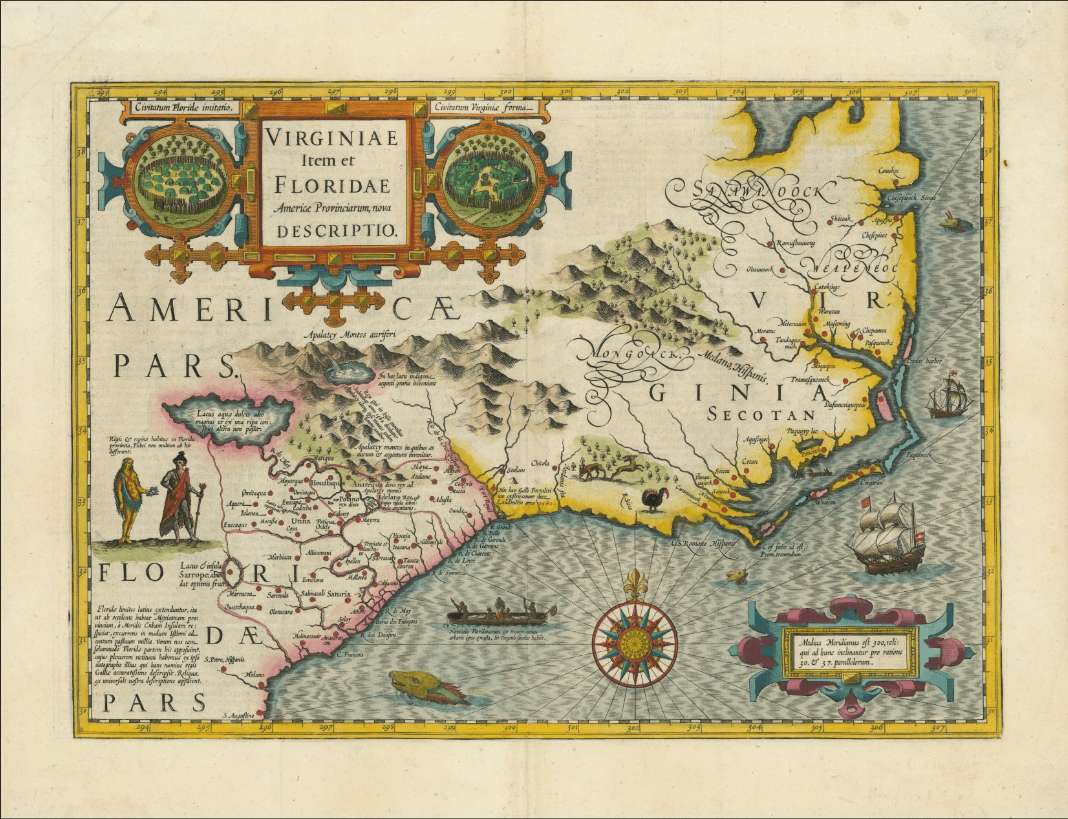
Hondius, Jodocus. Virginiae Item et Floridae Americae Provinciarum, Nova Descriptio. Amsterdam, c. 1606. Based on earlier accounts of Virginia and Florida. Hand-colored engraved map.
Ogilby's maps similarly portray multiple Indigenous men, women, and children with brown complexions.
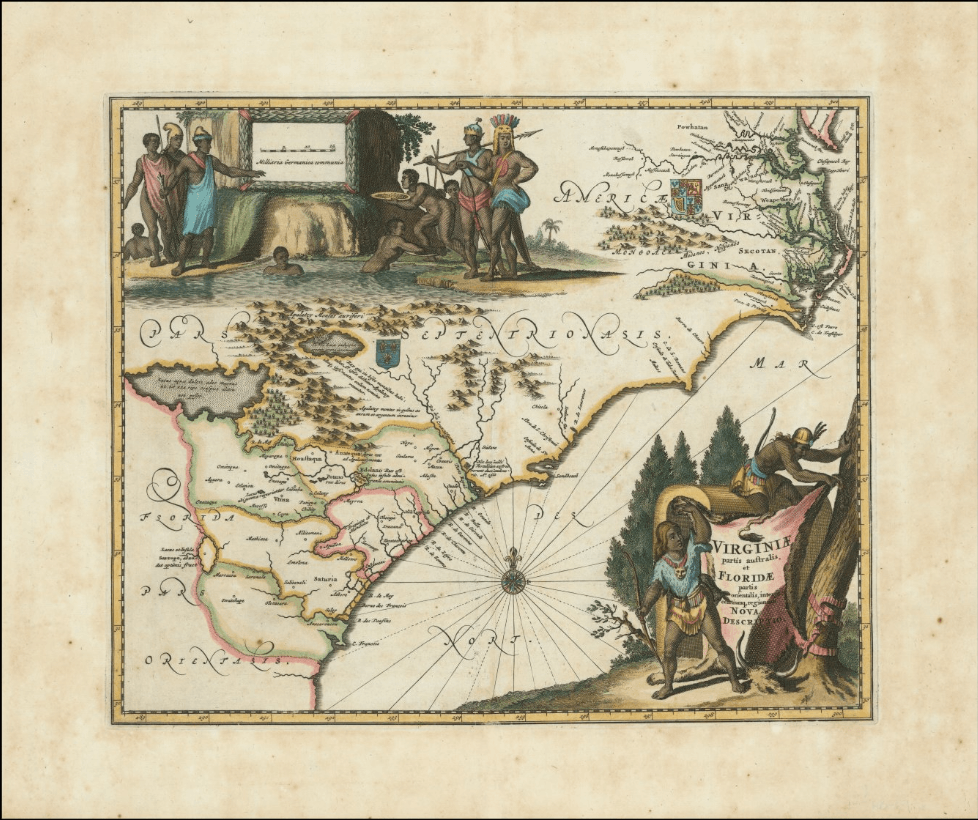
Ogilby, John. Virginiae Partis Australis, et Floridae Partis Orientalis, Interjacentiumque Regionum Nova Descriptio. In America: Being the Latest, and Most Accurate Description of the New World. London: Thomas Johnson, 1671.
Van der Aa's Florida map continues the same visual tradition into the early eighteenth century.
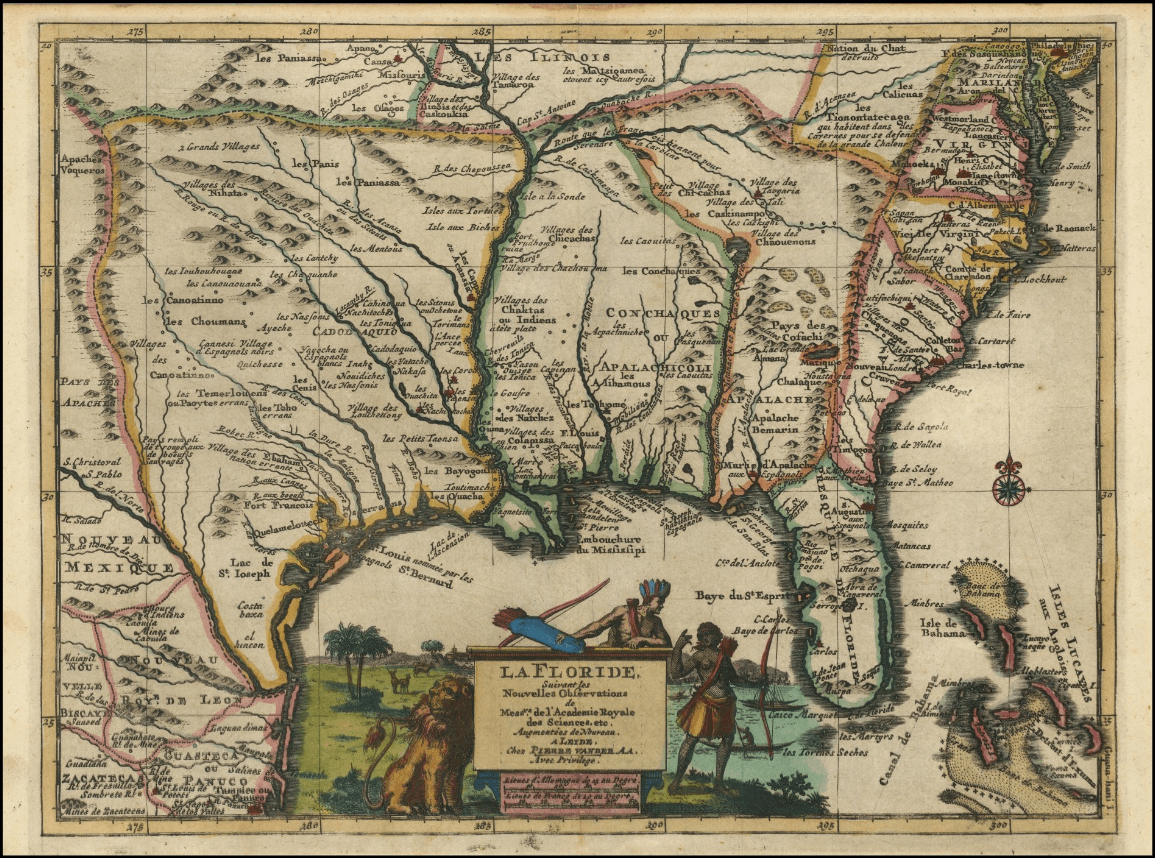
Van der Aa, Pieter. La Floride, Suivant les Nouvelles Observations de Messrs. de l'Académie Royale des Sciences, etc. Augmentée de Nouveau. Leiden, c. 1715. Engraved map of Florida and the southeastern region of North America.
These images do not prove exact appearance, but they demonstrate that European artists repeatedly chose to portray Southeastern peoples in ways consistent with contemporary textual descriptions.
Conclusion
The historical record does not present a single, uniform description of the Indigenous peoples of the Southeast. Instead, it presents a range of related descriptions recorded across several centuries.
Observers repeatedly described Southeastern peoples as:
Copper-colored
Reddish copper
Red-clay colored
Reddish brown
Brown
Dark brown
Cinnamon-complexioned
Olive-toned
They also consistently described them as black-haired, dark-eyed, well-proportioned, physically robust, and often tall in stature.
Equally important, many observers emphasized variation between nations and individuals, noting differences among Creek, Cherokee, Chickasaw, Yamasee, Seminole, Cofitachequi, and other peoples.
When viewed collectively, the evidence reveals a remarkable consistency. Across Spanish accounts, English traders, French observers, American travelers, ethnologists, and cartographers, the Indigenous peoples of the Southeast were repeatedly described using a vocabulary of earth-toned complexions and robust physical features. Whatever modern assumptions may exist, the historical descriptions themselves deserve careful consideration and close study.
Selected Sources
Adair, James. The History of the American Indians. London: Edward and Charles Dilly, 1775.
Bartram, William. Travels Through North and South Carolina, Georgia, East and West Florida. Philadelphia: James & Johnson, 1791.
Gatschet, Albert S. A Migration Legend of the Creek Indians. Philadelphia: D. G. Brinton, 1884.
Milford, Louis LeClerc de. Memoir, or a Quick Glance at My Various Travels and My Sojourn in the Creek Nation. Translated edition.
Swanton, John R. Early History of the Creek Indians and Their Neighbors. Bureau of American Ethnology Bulletin 73. Washington, D.C.: Smithsonian Institution, 1922.
Weld, Isaac. Travels Through the States of North America, and the Provinces of Upper and Lower Canada. London: John Stockdale, 1799.
Hondius, Jodocus. Floridae Americae Provinciae Recens & Exactissima Descriptio. Early seventeenth-century map.
Ogilby, John. America: Being the Latest, and Most Accurate Description of the New World. London, 1671.
Van der Aa, Pieter. Florida et Apalche. Early eighteenth-century map.
Let us know what you think in the comments!